
The Unnamed Three - I
A small framework where you decide what the game is about
RPGDESIGNOUR GAMES
Ali Kutlu Durşen
5/6/20263 min read
Origin and Motivation
The Unnamed Three's origins lie in laziness: I was scheduled to run a game at our monthly TTRPG event, and didn't feel like explaining a bunch of rules to potentially first time players. See, while I enjoy Pathfinder Second Edition very much, it can also be a bit too much to throw at new players if there is no previous discussion. This, as far as I can tell, is mainly due to spellcasting mechanics.
I also considered running our own Barbarian, Thief and Sorcerer but decided against it. While it's relatively simple to resolve subsystems, there are still quite a few of them. Yes, main culprit is once again spellcasting, but not the only one.
In other words, surprising no one, it's difficult to play a game without knowing the rules and the more rules a game has, the harder it is to pick up and play. No big deal, that just means there is a time and place for minimalism.
Design
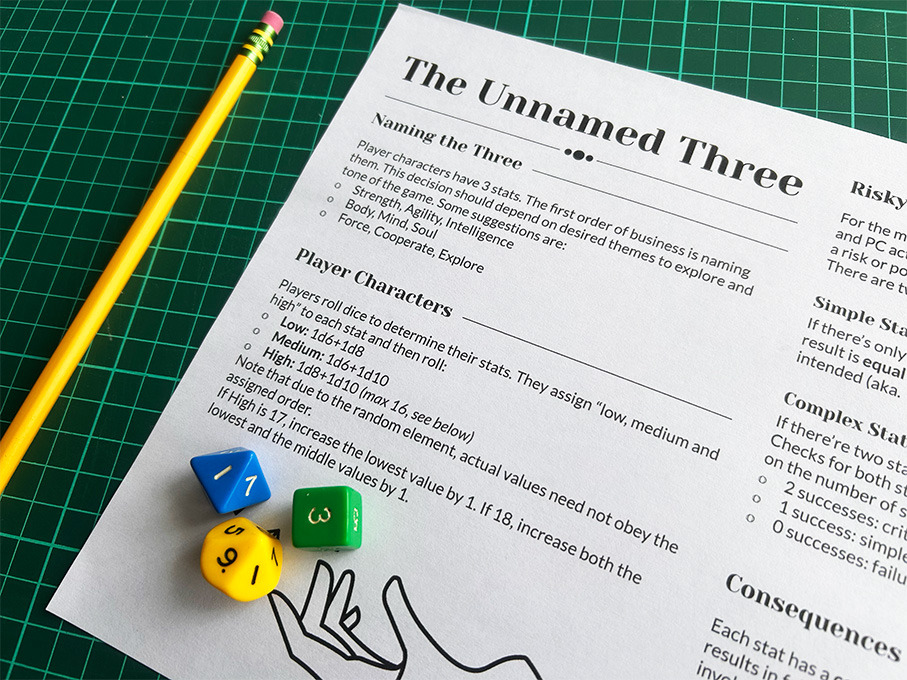
So I went as minimal as possible and put together a resolution framework and put it on a page. Let's examine my design choices step-by-step:
the Three: first, if you're familiar with my work, one theme will stick out to you: "Three is plenty". TTRPG characters, by virtue of being played by different people, are individuals. We do not need a lot of mechanical tools to differentiate them from another. (Such tools are useful for other reasons.) We should also be mindful of the scope. In designing a game that's meant to be played in a single 4-hour session at a convention, it benefits us little to have 10 abilities for each character. Thinking this, I settled on a game with three main stats.
Naming the Three: starting with "three is plenty" with a dash of "flavor is free," I sought a way to let GMs add their flavor to the game, to make the game serve them. It is no secret that names evoke the tone of a game. The skill lists, abilities, even saving throws tell a story. If that is the case, then should I be the one naming the skeleton of the game? Instead I gave that tool to the GM. Stats are what the game is about, and the GM knows what their game will be about. Therefore, gameplay starts with giving them a name. I also listed some examples (three examples, in fact. Remember what I said earlier?) to demonstrate that stats can be things that characters are, or they have, or even they do. Fun fact: I did use "Force, Cooperate, Explore" in my game.
Character Customization: yes, characters are individuals and customization is not vital. Still, I can't help but see character creation as an essential part of TTRPG experience. This is especially true in our case: if this game's target audience is first-time players, then I want to help them understand that it is their character that they are playing. I also like unpredictable elements in a small game, as I think it helps game's replayability. So I have players determining their stats randomly, and they get to pick which stat gets the probably-lower and probably-higher random generation method as a method of customization.
Dice to Roll: I imagined the game as a roll-under-stat from the beginning: to our target audience, it helps immensely to see the target number on their sheet. (Of course, there's a small design decision of roll-over versus roll-under, but I find "high stat is good" to be more intuitive than "high roll is good.") I also went with 2 dice to make extremes less likely and picked 2d8 over 2d6 or 2d10. There are some probability calculations that examine how this choice interacts with stats, but details are beyond the scope of this post. It is safe to say that this is primarily an aesthetic choice.
Checks: if our goal is simplicity, then "roll under" is as simple as it gets. As a bonus, I put a "multiple checks" subsystem to give GMs a tool to emphasize narrative stakes and drama. Nowhere did I define, or even wanted to define, what success, critical success or failure meant. As a narrative game, I wanted each table to find their own rhythm and assign their own meaning to those results as needed by the check in question.
Consequences: it may be the trad-gamer in me that's speaking, but it feels easier to be invested in a story if there's a (mechanical) stake that I can see on my character sheet. First, I considered giving characters a reroll pool, as well as a hit point tracker of sorts called consequence. Then, inspired by Dragonbane's conditions tied to an ability, I first tied each consequence to an ability. Afterwards, inspired by Forbidden Lands' "risky reroll" mechanic, I also tied rerolls to consequences and by extension, to abilities. (I guess I was in a Free League phase back then!) This led to a risk-reward play with consequences.
Next Up
On our next post, we will offer a post-mortem of the game as it played on the table, and as an one-page RPG.